Academic Tutorials


English | French | Portugese | German | Italian
Google

Home Source Codes E-Books Downloads Contact Us About Us

Data Structures Using C
Introduction to Data Structures
Pointers and Indirection
Linear Data Structures
Stacks: The Abstract View
Queues: The Abstract View
Introduction to Trees
Introduction to Graphs

HTML Tutorials
HTML Tutorial
XHTML Tutorial
CSS Tutorial
TCP/IP Tutorial
XML Tutorials
XML Tutorial
XSL Tutorial
XSLT Tutorial
DTD Tutorial
Schema Tutorial
XForms Tutorial
XSL-FO Tutorial
XML DOM Tutorial
XLink Tutorial
XQuery Tutorial
XPath Tutorial
XPointer Tutorial
RDF Tutorial
SOAP Tutorial
WSDL Tutorial
RSS Tutorial
WAP Tutorial
Web Services Tutorial
Browser Scripting
JavaScript Tutorial
VBScript Tutorial
AJAX Tutorial
DHTML Tutorial
HTML DOM Tutorial
WMLScript Tutorial
E4X Tutorial
Server Scripting
ASP Tutorial
PHP Tutorial
PERL Tutorial
SQL Tutorial
ADO Tutorial
.NET (dotnet)
Microsoft.Net
XML Web Services
ASP.Net
.Net Mobile
C# : C Sharp
ADO.NET
VB.NET
Multimedia
SVG Tutorial
Flash Tutorial
Media Tutorial
SMIL Tutorial
Web Building
Web Browsers
Web Hosting
W3C Tutorial
Web Building
Web Quality
Web Semantic
Web Careers
Java Tutorials
Java Tutorial
JSP Tutorial
Servlets Tutorial
Struts Tutorial
EJB Tutorial
JMS Tutorial
JMX Tutorial
Programming Langauges
C Tutorial
C++ Tutorial
Visual Basic Tutorial
Data Structures Using C
Soft Skills
Communication Skills
Time Management
Project Management
Team Work
Leadership Skills
Corporate Communication
Negotiation Skills


Introduction to Data Structures

Previous Next


Imagine that the company ABC has hired you to organize all of their records into a computer database. The first thing you are asked to do is to create a database which consists of all the names of all the company's employees. To start, you make a list of everyone in the company along with their positions.


Name Position
Aaron Manager
Charles VP
George Employee
Jack Employee
Janet VP
John President
Kim Manager
Larry Manager
Martha Employee
Patricia Employee
Rick Secretary
Sarah VP
Susan Manager
Thomas Employee
Zack Employee


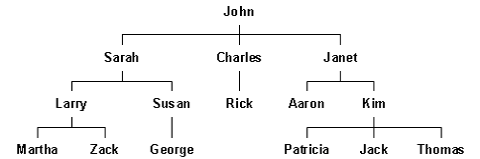
But only one view of the company is shown by the above list. You also want the database to represent the relationships between employees and management at ABC. It does not tell you which managers are responsible for which workers and so on, although your list contains both name and position. After thinking about the problem for a while. You decide that the tree diagram is much better structure for showing the work relationships at the ABC company.


These two above diagrams are examples of the different data structures. Your data is organized into a list, in one of the data structures which is above. The employees name can be stored in alphabetical order so that we can locate the employee's record very quickly. For showing the relationships between employees these structure is not very useful. The tree structure is a much better suited for this purpose.

The data structures are an important way of organizing information in a computers. There are many different data structures that programmers use to organize data in computers, just like the above illustrated diagrams. Some of the data structures are similar to the tree diagram because they are good for representing the relationships between different data. Other structures are good for ordering the data in a particular way like the list of employees which is shown above. Each data structure has their own unique properties that make it well suited to give a certain view of the data.


By the end of this tutorial, you should be able to do the following:

  • Show how data structures are represented in the computer,
  • Identify linear and nonlinear data structures,
  • Manipulate data structures with basic operations, and
  • Compare different implementations of the same data structure.


Share And Enjoy:These icons link to social bookmarking sites where readers can share and discover new web pages.
  • blinkbits
  • BlinkList
  • blogmarks
  • co.mments
  • connotea
  • del.icio.us
  • De.lirio.us
  • digg
  • Fark
  • feedmelinks
  • Furl
  • LinkaGoGo
  • Ma.gnolia
  • NewsVine
  • Netvouz
  • RawSugar
  • Reddit
  • scuttle
  • Shadows
  • Simpy
  • Smarking
  • Spurl
  • TailRank
  • Wists
  • YahooMyWeb

Previous Next

Keywords: Introduction to Data Structures, visual basic introduction, computer science introduction, c++ structures, c++ introduction, introduction exercises, engineering structures, computer introduction, introduction to data analysis, introduction programming, introduction engineering, introduction examples


HTML Quizes
HTML Quiz
XHTML Quiz
CSS Quiz
TCP/IP Quiz
XML Quizes
XML Quiz
XSL Quiz
XSLT Quiz
DTD Quiz
Schema Quiz
XForms Quiz
XSL-FO Quiz
XML DOM Quiz
XLink Quiz
XQuery Quiz
XPath Quiz
XPointer Quiz
RDF Quiz
SOAP Quiz
WSDL Quiz
RSS Quiz
WAP Quiz
Web Services Quiz
Browser Scripting Quizes
JavaScript Quiz
VBScript Quiz
AJAX Quiz
DHTML Quiz
HTML DOM Quiz
WMLScript Quiz
E4X Quiz
Server Scripting Quizes
ASP Quiz
PHP Quiz
PERL Quiz
SQL Quiz
ADO Quiz
.NET (dotnet) Quizes
Microsoft.Net Quiz
XML Web Services Quiz
ASP.Net Quiz
.Net Mobile Quiz
C# : C Sharp Quiz
ADO.NET Quiz
VB.NET Quiz
Multimedia Quizes
SVG Quiz
Flash Quiz
Media Quiz
SMIL Quiz
Web Building  Quizes
Web Browsers Quiz
Web Hosting Quiz
W3C Quiz
Web Building Quiz
Web Quality Quiz
Web Semantic Quiz
Web Careers Quiz
Java Quizes
Java Quiz
JSP Quiz
Servlets Quiz
Struts Quiz
EJB Quiz
JMS Quiz
JMX Quiz
Programming Langauges Quizes
C Quiz
C++ Quiz
Visual Basic Quiz
Data Structures Using C Quiz
Soft Skills Quizes
Communication Skills Quiz
Time Management Quiz
Project Management Quiz
Team Work Quiz
Leadership Skills Quiz
Corporate Communication Quiz
Negotiation Skills Quiz

Privacy Policy
Copyright © 2003-2008 Vyom Technosoft Pvt. Ltd., All Rights Reserved.